
Acupuncture
The Miracle of Molting: Surrender into Certainty
Photo by Greg Daines on Unsplash
“Shedding is an act of involuntary bravery.
We do not choose when our skin grows too tight for us.
We are split open from the inside out
by the pressure of our own growth.”
~~ David Whyte
Greetings to all my precious people,
I want to tell you something true about the caterpillar, because we’ve romanticized it into something gentler than it actually is.
Inside the chrysalis, the caterpillar does not gracefully rearrange itself into a butterfly. It dissolves. Nearly its entire body breaks down into a kind of living soup — cell walls collapsing, structure gone, no shape left that anyone would recognize as a creature. And here is the part almost no one tells you: scattered throughout that soup are clusters of cells called imaginal cells, which have carried the blueprint of the butterfly all along, dormant, waiting. At first, the caterpillar’s own immune system attacks them. Treats them as foreign invaders. Fights the very thing that is trying to save it, because it doesn’t yet recognize its own becoming. continue reading
Returning to Source: Surrender into Certainty

Photo by Sebastian Engler on Unsplash
“Returning to the source is stillness,
which is the way of nature.
The way of nature is unchanging.
Knowing constancy is insight.”
~~ Lao Tzu, Tao Te Ching
Greetings to all my precious people,
The geese are gone now. What’s left behind is quieter work, and it happens where no one can see it.
Above ground, the trees look like they’re dying. Leaves gold, then rust, then gone. But below ground, something else entirely is happening — the sap that spent all summer reaching upward toward light is pulling back down now, into the roots, into the deep dark storage the tree has been quietly maintaining the whole time it looked like it was only reaching up. Nothing about this is loss. It’s consolidation. The tree isn’t disappearing. It’s remembering where its life actually lives. continue reading
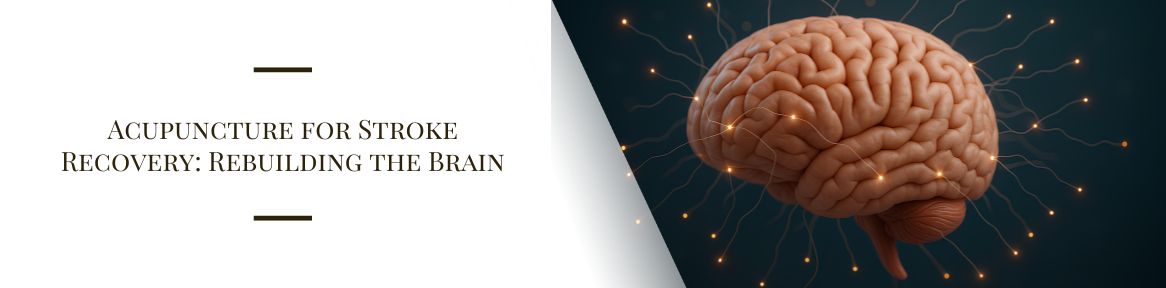
Acupuncture for Stroke Recovery: Rebuilding the Brain
When a stroke hits, life can change in an instant. One moment you’re preparing breakfast before work, and the next you’re on the kitchen floor unable to move one side of your body. The weeks that follow are then filled with hospital visits, rehabilitation appointments, and often frustration. Tasks once performed automatically like buttoning a shirt, lifting a coffee cup, or speaking clearly, become daily battles.
Months of physical therapy can then follow, but progress is often slow. Speech can remain slurred and fatigue can be relentless. Many are desperate for additional help and can look to acupuncture to help with recovery. While acupuncture is not a replacement for emergency medicine or rehabilitation therapy, growing clinical research suggests it may offer meaningful benefits for some patients recovering from stroke. continue reading
Migration & Knowing When to Leave: Surrender into Certainty
Photo by Gary Bendig on Unsplash
“It is always important to know when something has reached its end.
Closing circles, shutting doors, finishing chapters…
what matters is to leave in the past those moments in life that are over.”
~~ Paulo Coelho
Greetings to all my precious people, my fellow travelers,
You’ve been standing at doorways for three weeks now. This week, we walk through one.
Overhead, the geese aren’t practicing formation anymore. They’re gone — or going. Nobody called a meeting. No committee reviewed the data on when, exactly, to leave. Something in them simply knew, the way it has known for longer than any of our calendars have existed, and they went.
I want to be honest about something most migration stories skip past: knowing when to leave and knowing where to go are not the same knowing. Geese have both, wired in together. We rarely get both at once. Usually we get the first — a restlessness, a door that’s suddenly, undeniably closed, a chapter that has plainly ended even if we can’t yet see the next one’s title. Coelho’s line isn’t really about destinations. It’s about having the courage to close the circle before you know what the next one looks like. continue reading
The Equinox and Liminal Spaces: Surrender to Certainty

Photo by Paul Pastourmatzis on Unsplash
“You’re afraid of surrender
because you don’t want to lose control.
But you never had control;
all you had was anxiety.”
~~ Elizabeth Gilbert
Greetings to all my precious people!!
Right now, we are standing in a doorway.
Tuesday brought us the Autumn Equinox — the exact moment day and night stood equal, the cosmos balanced for one instant on a knife’s edge before tipping toward the dark half of the year. The Celts called places like this “thin places” — shorelines, riverbanks, the hush of dusk — locations and moments where the veil between worlds goes porous. What most of us haven’t considered is that a day can be a thin place too. This one was.
But a threshold isn’t a place you stand still in. It’s a place you either walk through, or resist. continue reading


