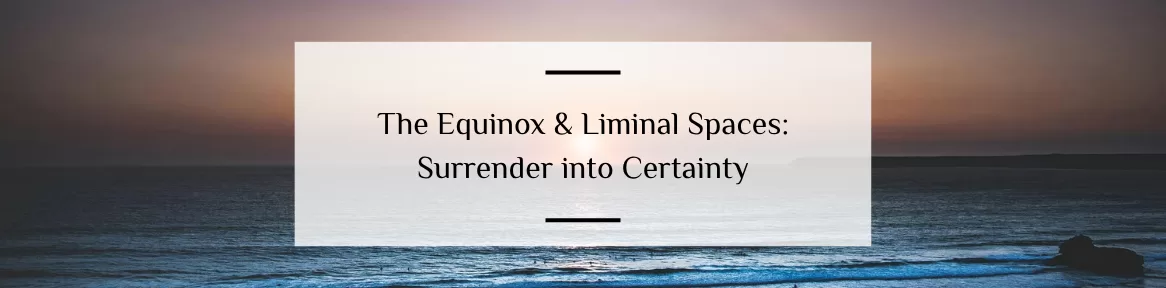
Photo by Paul Pastourmatzis on Unsplash
“You’re afraid of surrender
because you don’t want to lose control.
But you never had control;
all you had was anxiety.”
~~ Elizabeth Gilbert
Greetings to all my precious people!!
Right now, we are standing in a doorway.
Tuesday brought us the Autumn Equinox — the exact moment day and night stood equal, the cosmos balanced for one instant on a knife’s edge before tipping toward the dark half of the year. The Celts called places like this “thin places” — shorelines, riverbanks, the hush of dusk — locations and moments where the veil between worlds goes porous. What most of us haven’t considered is that a day can be a thin place too. This one was.
But a threshold isn’t a place you stand still in. It’s a place you either walk through, or resist.
That’s the part I want to sit with this week — not the equinox as an event, but the equinox as a choice. Do we flow with the natural turning of things, present at every twist of the river? Or do we plant our feet and fight the current, spending everything we have holding a summer that has already, gently, let go of us?
Gilbert’s line is the whole answer, really: we’re afraid of surrender because we think it means losing control. But the control was never real to begin with. What we actually had, gripping the banks of a river that was always going to keep moving, was anxiety wearing control’s clothing. Surrender doesn’t cost us anything we actually had.
The Celts told this same truth through myth instead of psychology. At this threshold, the young, life-giving Brigid doesn’t battle the Cailleach — the blue-faced crone of winter and storm — for sovereignty over the land. She hands it to her. Gently. On purpose. Two faces of one goddess, trading places the way a held breath finally, naturally, becomes an exhale.
Taoist philosophy draws the identical picture in the Taijitu, the yin-yang symbol: even at Yang’s absolute peak, a small dot of Yin is already curled inside it, waiting its turn. Neither tradition treats this as a war between light and dark. Both treat it as one continuous, trustworthy motion — the same river, still flowing, just changing which bank it favors.
This is what I mean when I say Surrender into Certainty. Not certainty that nothing will change. Certainty that the change itself is the most reliable thing there is — and that we were built, the same as Brigid, the same as every tree pulling its sap back down to the root, to move with it rather than against it.
A small practice for standing in the doorway:
At dusk this week — that daily thin place, neither fully day nor night — pause wherever you are. Ask yourself one honest question: where in my life am I gripping the bank, calling it control, when it’s really just anxiety? You don’t have to answer it fully. Just let the question sit in the thin light for a moment. That’s the whole practice. Some things, like the equinox itself, only need a moment to do their work.
A three-phase practice for the doorway, body and all:
Taoist tradition doesn’t just describe this threshold philosophically — it gives you a body to do it with. Here’s a sequence that moves you through the same three phases the Celts mapped onto the doorway itself: separation, the threshold, and integration.
Phase One — Separation (Letting the old season go). Sit or stand with a straight spine, shoulders soft. Place two fingers on Lung 7 — the small hollow just above your wrist bone, on the thumb side of your forearm — a point Taoist medicine has long used to help the body release what it’s finished carrying. Inhale through the nose for a count of four. Exhale slowly through the mouth on a soft “sssshhh,” the traditional healing sound of the Lungs, for a count of six. As you exhale, mentally name one thing from summer — a project, a way of being, a worry — that you’re ready to set down at this threshold. Repeat for five or six breaths. This is Metal doing its work: not force, just release.
Phase Two — The Threshold (Standing in the Void). Let your hands come to rest, one over the other, just below your navel — the Dan Tien, the body’s own quiet center. Close your eyes. Don’t reach for anything here — no intention, no direction, no fixing. In Taoist terms, this is the Wuji, the unmanifested pause before Yin and Yang differentiate again. Just breathe naturally and let yourself be, for as long as feels honest — thirty seconds is enough if that’s all you have. This is the body’s version of the Celtic thin place: neither the old self nor the new one, simply present in the doorway.
Phase Three — Integration (Welcoming what’s next). Bring your hands to your chest, one crossing the other, gently over the heart. Take one full, deep breath in, and as you exhale, silently welcome one quality you want to carry into the dark half of the year — clarity, rest, softness, whatever rises. Open your eyes. Place your palms flat on your thighs or on the earth if you’re outside, feeling the ground receive you the way it received the last of the harvest. You’ve crossed. You don’t have to announce it. Your body already knows.
We didn’t choose the turning. We never do. But we get to choose, every single time, whether we walk through the door or brace against the frame.
“Accept things humbly;
surrender them willingly.”
~~ Marcus Aurelius


